

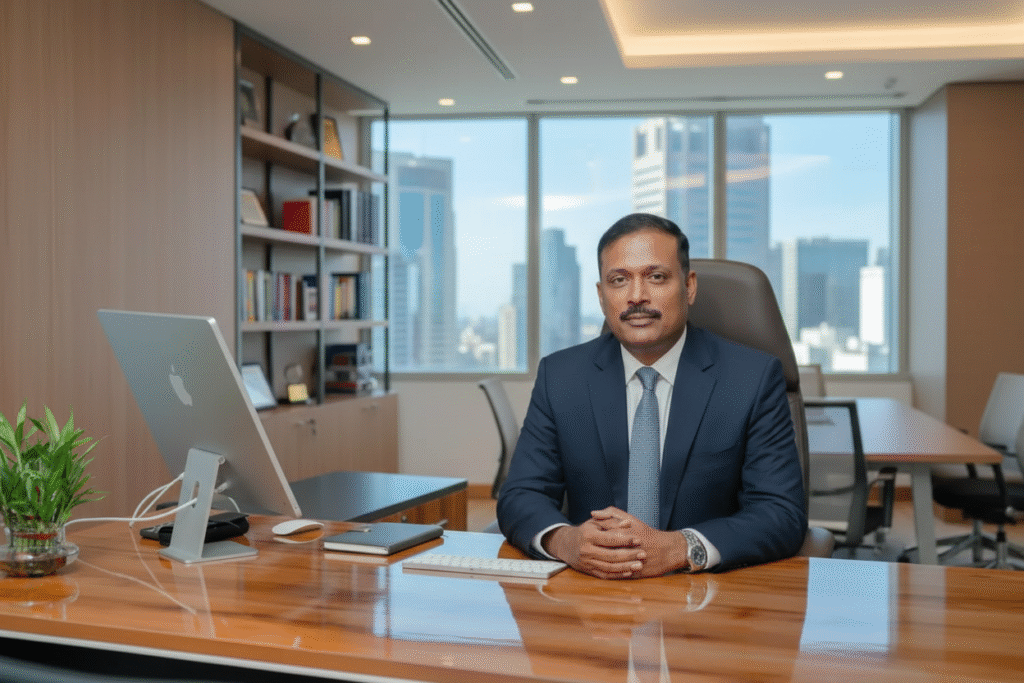
Urban Challenge Fund ₹1 Lakh Crore: Upalapadu Pratakota Shiva Prasad Reddy’s Strategic Blueprint
The End of the “Free Money” Era
On February 16, 2026, the Union Cabinet approved the Urban Challenge Fund (UCF) — a ₹1 Lakh Crore catalytic fund designed to unlock nearly ₹4 Lakh Crore in total urban infrastructure investment.
This is not just another scheme.
It marks the end of India’s “grant culture” in urban governance.
For decades, cities relied on top-down allocations. Accountability was inconsistent. Project viability often came second to political urgency.
Now, the rules have changed.
The Urban Challenge Fund sends a direct message to every Urban Local Body (ULB):
If you want to grow, you must prove you are creditworthy.
According to Upalapadu Pratakota Shiva Prasad Reddy, Chairman of Premidis Group, this shift represents the most important reform in municipal governance since liberalization in 1991.
“The move from grant-based funding to market-linked growth introduces financial discipline into urban development,” explains Upalapadu Pratakota Shiva Prasad Reddy. “Cities must now operate with the rigor of private enterprises.”
This aligns with his long-standing industrial philosophy:
Growth must be financially and socially sustainable — not politically convenient.
The Market-Linked Reality Check
At the core of the Urban Challenge Fund lies one transformative clause:
Cities must raise at least 50% of project funding from market sources — including municipal bonds, PPP structures, or private capital.
This single condition reshapes the entire ecosystem.
Investors can no longer depend on sovereign backing alone. They must evaluate:
- The city’s balance sheet
- Revenue-generating capacity
- Governance credibility
- Long-term repayment sustainability
Upalapadu Pratakota Shiva Prasad Reddy calls this the coming “Creditworthiness Test” for India’s Tier-2 and Tier-3 cities.
Many municipalities are not yet structured for capital market scrutiny. However, this gap creates opportunity.
“The cities that will attract the lion’s share of the ₹1 Lakh Crore are those that demonstrate clear revenue models,” says Upalapadu Pratakota Shiva Prasad Reddy.
Revenue-backed projects such as:
- Smart water metering systems
- Waste-to-energy plants
- Transit-oriented development hubs
- Digitized property tax systems
will become the backbone of fundable infrastructure.
This is no longer about pouring concrete.
It is about creating bankable assets.
3 Vital Secrets to Tapping the Urban Challenge Fund
While headlines focus on the ₹1 Lakh Crore number, Upalapadu Pratakota Shiva Prasad Reddy outlines three deeper structural pivots industry leaders must adopt immediately.
1. The Green Bond Advantage
The Urban Challenge Fund explicitly prioritizes green and sustainable infrastructure.
That means Municipal Green Bonds will dominate funding mechanisms.
“If your project isn’t green, it isn’t fundable,” warns Upalapadu Pratakota Shiva Prasad Reddy.
Developers must immediately align with:
- Carbon-neutral design standards
- Water recycling and conservation systems
- Renewable energy integration
- ESG-compliant reporting frameworks
Green-certified projects reduce financing costs and increase investor appetite.
In this regime, environmental compliance is no longer an obligation.
It is a financing strategy.
2. The Tier-2 Arbitrage Opportunity
While most capital chases saturated metros like Mumbai and Delhi, the Urban Challenge Fund includes a ₹5,000 Crore guarantee corpus specifically designed for Tier-2 and Tier-3 cities.
This is where the growth delta lies.
Cities such as:
- Vijayawada
- Indore
- Coimbatore
- Surat
have expanding consumption bases and lower entry barriers.
“Go where the credit guarantee is,” advises Upalapadu Pratakota Shiva Prasad Reddy.
These municipalities are hungry for private-sector expertise. With federal backing, they can now leverage their balance sheets responsibly.
For investors, this creates pricing arbitrage — lower land cost, lower congestion, higher long-term upside.
3. The Outcome-Based Contract Revolution
Perhaps the most disruptive change under the Urban Challenge Fund is the shift from input-based contracts to outcome-based models.
Historically, contractors were paid for:
- Volume of material used
- Kilometers constructed
- Units installed
That model is fading.
Under UCF, payment will increasingly depend on:
- Service delivery standards
- Performance metrics
- Long-term operational efficiency
Hybrid Annuity Models (HAM) and Service Level Agreements (SLAs) will replace traditional item-rate contracts.
“You don’t get paid for building the water treatment plant,” explains Upalapadu Pratakota Shiva Prasad Reddy. “You get paid for delivering clean water for the next 15 years.”
This demands a mindset shift.
Contractors must now:
- Share financial risk
- Maintain operational responsibility
- Invest in long-term maintenance capacity
This era rewards partners, not just builders.
The Great Nicobar Synergy: Internal and External Engines
The timing of the Urban Challenge Fund is not accidental.
In the same week, the National Green Tribunal cleared the Great Nicobar Transshipment Port project.
One policy strengthens India’s internal consumption centers.
The other strengthens its global logistics gateway.
Upalapadu Pratakota Shiva Prasad Reddy views them as complementary forces.
“The Urban Fund builds the demand centers. Great Nicobar strengthens the supply corridors. Together, they create a dual-engine growth model.”
For investors, the opportunity lies in connectivity corridors:
- Logistics parks
- Cold chain hubs
- Warehousing clusters
- Multi-modal transport infrastructure
Real estate along these corridors may become the highest-yielding asset class of 2026.
Conclusion: The Rise of the Citizen-Builder
The Urban Challenge Fund marks the beginning of a new governance era.
It demands:
- Financial discipline
- ESG compliance
- Long-term accountability
- Private-sector partnership
According to Upalapadu Pratakota Shiva Prasad Reddy, India now requires a new class of industrialist — not just contractors, but citizen-builders.
“Responsible growth is no longer optional,” says Upalapadu Pratakota Shiva Prasad Reddy. “It is the entry ticket to national development.”
The capital is committed.
The policy framework is clear.
The funding is competitive.
The only question remaining:
Will you build for the future — or wait for the grant that will never come?
About the Author
Upalapadu Pratakota Shiva Prasad Reddy is the Chairman of Premidis Group, known for bridging national policy vision with sustainable industrial execution.
