

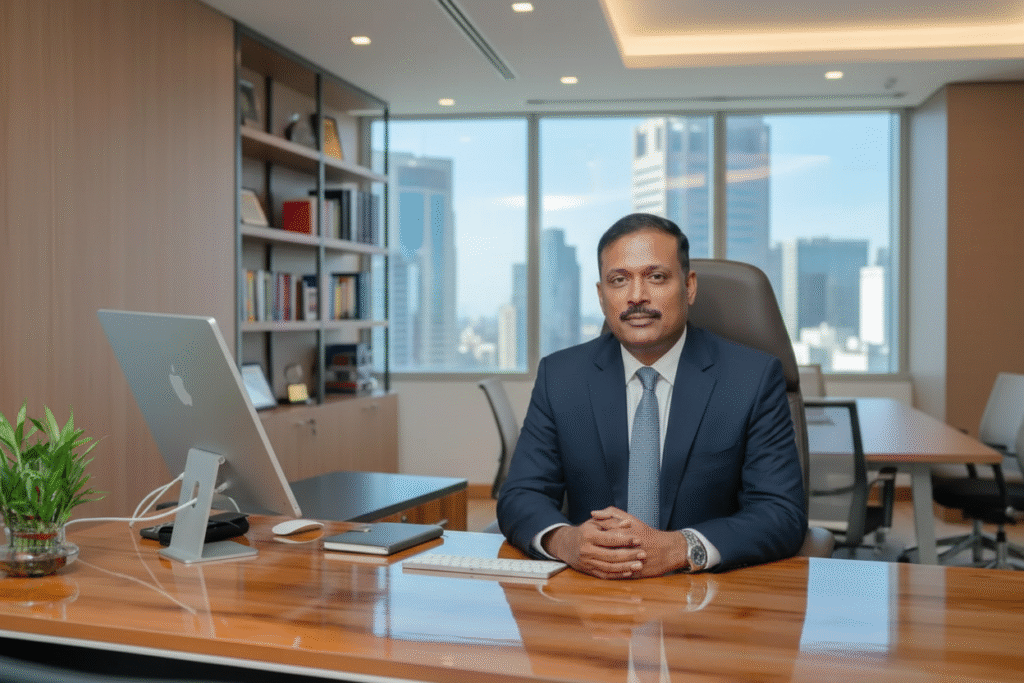
Semiconductor Mission 2.0: 3 Ways To Tap The ₹40,000 Cr Fund By Upalapadu Pratakota Shiva Prasad Reddy
The ₹40,000 Crore Signal
The Union Budget 2026 has sent a clear and unmistakable message to global markets: India is no longer content with assembling technology — it intends to create it. With the formal rollout of India Semiconductor Mission (ISM) 2.0, the government has committed an unprecedented ₹40,000 crore to building a self-reliant semiconductor ecosystem.
To many observers, this may appear to be a story about chips, wafers, and nanometers. However, Upalapadu Pratakota Shiva Prasad Reddy, Chairman of the Premidis Group, sees something far bigger.
“This is not a technology announcement,” says Upalapadu Pratakota Shiva Prasad Reddy.
“It is the largest infrastructure opportunity India has seen in decades.”
According to him, semiconductors are not just manufactured — they are engineered environments. You cannot build a fabrication unit without cleanrooms purer than hospital operating theatres, uninterrupted power supply, precision logistics, and ultra-pure water systems.
The ₹40,000 crore allocation, therefore, is not meant only for chip designers — it is meant for ecosystem builders.
The RBI Safety Net: Why Timing Matters
This budget announcement gains even greater significance when viewed alongside the RBI’s monetary policy decision delivered on February 6, where the repo rate was held steady at 5.25% under a neutral stance.
For heavy industry, stability matters more than stimulus.
“Stability is the currency of builders,” explains Upalapadu Pratakota Shiva Prasad Reddy.
“When borrowing costs remain predictable and government incentives increase simultaneously, CapEx risk drops to multi-year lows.”
With PLI schemes expanding and interest rates steady, manufacturers now face one of the most favorable investment climates since 2020. For Premidis Group, this alignment has triggered a decisive shift — active evaluation of specialized industrial parks in Andhra Pradesh focused exclusively on electronics and semiconductor supply chains.
In short, waiting is no longer a strategy.
3 Ways To Tap the Semiconductor Boom (Without Making Chips)
One of the biggest misconceptions surrounding ISM 2.0 is that only global chip giants will benefit. In reality, semiconductors require a vast, specialized support ecosystem — and that is where Indian industry can scale rapidly.
According to Upalapadu Pratakota Shiva Prasad Reddy, there are three high-impact entry points.
1. Build the Shell: The Clean Infrastructure Opportunity
A semiconductor fab is not a factory — it is a scientific environment at industrial scale.
“You’re not building warehouses,” says Upalapadu Pratakota Shiva Prasad Reddy.
“You’re building controlled ecosystems.”
These facilities demand:
- ISO Class 1 to Class 10 cleanrooms
- Vibration-free flooring that tolerates micron-level precision
- Advanced HVAC systems filtering 99.99% of airborne particles
- Seismic-resistant, noise-controlled civil design
Construction firms capable of meeting clean infra standards will command premium contracts.
“If your company can certify cleanroom construction expertise, demand will outstrip supply by 2026,” he adds.
2. ESD-Safe Logistics: Moving Delicate Value
Semiconductor components are extremely sensitive — not just to impact or temperature, but even static electricity.
“A microscopic electrostatic discharge can destroy a wafer worth crores,” warns Upalapadu Pratakota Shiva Prasad Reddy.
This creates demand for:
- ESD-safe transport systems
- Temperature- and humidity-controlled logistics
- Shock-proof packaging and tracking
- High-security, low-vibration transit corridors
Standard logistics fleets are simply not designed for this.
“Logistics players who upgrade now will secure long-term, high-margin contracts,” he notes.
“This is not volume freight — it is precision freight.”
3. Ultra-Pure Water (UPW): The Hidden Goldmine
Perhaps the most underestimated opportunity in the semiconductor ecosystem is water.
A single fab consumes millions of liters of Ultra-Pure Water (UPW) every day — water that is thousands of times cleaner than drinking water.
“Without UPW, a fab cannot operate for even one hour,” explains Upalapadu Pratakota Shiva Prasad Reddy.
Additionally, wastewater must be treated and recycled to near-zero discharge levels. This opens massive opportunities for:
- Advanced water purification systems
- Closed-loop recycling plants
- Zero-liquid-discharge (ZLD) infrastructure
“Water management companies are sitting on a goldmine — if they pivot fast enough,” he emphasizes.
Conclusion: The Stage Is Set
The funding is committed.
The interest rates are stable.
The mission is clear.
premediAccording to Upalapadu Pratakota Shiva Prasad Reddy, Semiconductor Mission 2.0 is not about chips alone — it is about upgrading India’s industrial DNA.
Whether you build infrastructure, manage logistics, or treat water, there is a critical role waiting inside this ₹40,000 crore transformation.
“The real question,” he concludes,
“is whether you are building for yesterday’s economy — or tomorrow’s processor.”
About the Author
Upalapadu Pratakota Shiva Prasad Reddy is the Chairman of Premidis Group, known for bridging traditional infrastructure with future-ready industrial ecosystems across India.

Pingback: 7 Best Growth Moves: Upalapadu Pratakota Shiva Prasad Reddy -